What is a regular polygon?
A regular polygon is a closed plane shape with the same length on every side and the same measure for every interior angle. Equilateral triangles, squares, regular pentagons, hexagons, octagons and many other n-gons are regular polygons.
The key to understanding a regular polygon is its center. Draw segments from the center to every vertex and the polygon breaks into n congruent isosceles triangles. That one construction connects the side length, circumradius, apothem, area, perimeter and angles.
From triangle to n-gon
The number of sides determines the familiar name and the characteristic angles. The same formulas work for every regular n-gon; only n changes.
| Polygon | n | Interior α | Exterior β | Central angle |
|---|---|---|---|---|
| Equilateral triangle | 3 | 60° | 120° | 120° |
| Square | 4 | 90° | 90° | 90° |
| Pentagon | 5 | 108° | 72° | 72° |
| Hexagon | 6 | 120° | 60° | 60° |
| Heptagon | 7 | 128.57° | 51.43° | 51.43° |
| Octagon | 8 | 135° | 45° | 45° |
| Nonagon | 9 | 140° | 40° | 40° |
| Decagon | 10 | 144° | 36° | 36° |
| Dodecagon | 12 | 150° | 30° | 30° |
Regular polygon formulas
Let n be the number of sides, a the side length, R the circumradius and r the inradius (apothem).
Perimeter
Add n equal sides.
Area from side
Useful when side length is known.
Area from apothem
Split the polygon into n triangles.
Inradius / apothem
Center-to-side distance.
Circumradius
Center-to-vertex distance.
Angles
β = 360°/n
Interior and exterior angles.
Apothem, circumradius and the side
Three lengths appear repeatedly in regular-polygon geometry. The circumradius R reaches from the center to a vertex. The apothem r reaches perpendicularly from the center to the midpoint of a side. The side length a connects adjacent vertices.
Interior, exterior and central angles
The interior angles become larger as n increases, while each exterior and central angle becomes smaller. Three different angles are useful, and confusing them is one of the most common regular-polygon mistakes.
Worked examples
Side = 10 cm, n = 6
P = 6×10 = 60 cm.
A = 6×10²×cot(30°)/4 ≈ 259.81 cm².
Interior angle = 120°, exterior angle = 60°.
Perimeter = 50 cm, n = 5
Side a = P/n = 50/5 = 10 cm.
Then r and R follow from the tangent and sine formulas.
Side = 4 m, n = 8
P = 32 m.
Interior angle = 135° and exterior angle = 45°.
Area ≈ 77.25 m².
Where regular polygons are used
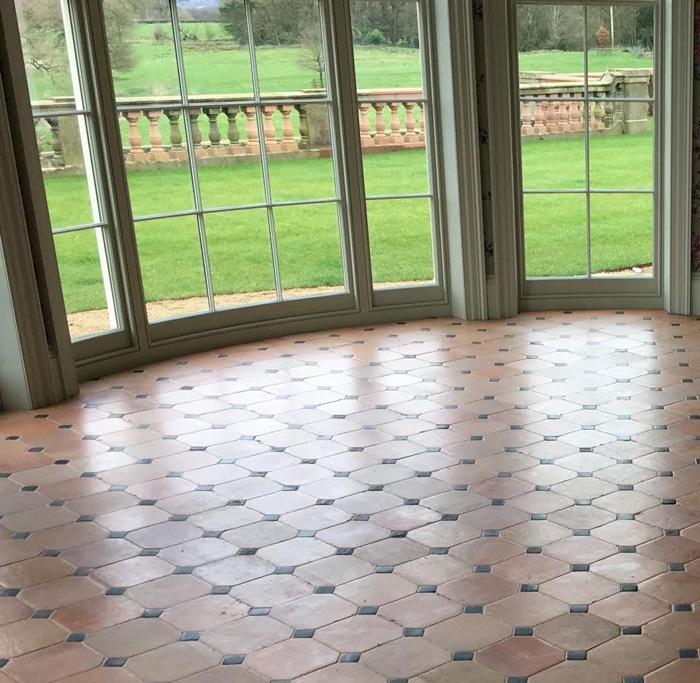
Regular polygons are not only classroom shapes. Their symmetry makes them useful in signs, decorative tiling, product design, architecture and technical drawings.

A quick reference table
| Name | n | Interior α | Exterior β | Common example |
|---|---|---|---|---|
| Triangle | 3 | 60° | 120° | Equilateral triangle |
| Square | 4 | 90° | 90° | Tile / frame |
| Pentagon | 5 | 108° | 72° | Symmetric motifs |
| Hexagon | 6 | 120° | 60° | Honeycomb-inspired design |
| Octagon | 8 | 135° | 45° | Stop sign |
| Decagon | 10 | 144° | 36° | Decorative geometry |
| Dodecagon | 12 | 150° | 30° | Architectural details |
Common mistakes
Interior and exterior angles are supplementary at a vertex: α + β = 180°.
R reaches a vertex; r reaches a side midpoint.
When n = 4, the regular polygon is a square and the general formulas still work.
Use the same length unit for side, radius and perimeter. Area uses the squared unit.
Regular polygon calculator FAQ
What makes a polygon regular?
Every side has the same length and every interior angle has the same measure.
What is an apothem?
The apothem is the perpendicular distance from the center of a regular polygon to one of its sides. It is also the inradius of the inscribed circle.
Can I calculate the polygon from perimeter instead of side length?
Yes. With n known, the side is simply a = P/n. The remaining properties can then be derived.
What happens as n becomes very large?
The polygon approaches a circle when its circumradius is held fixed. The live circle-coverage chart makes this convergence visible.
What is the difference between circumradius and inradius?
The circumradius passes through every vertex; the inradius (apothem) touches every side at its midpoint.