What is a square?
A square is a four-sided polygon with four equal sides and four right angles. Its symmetry is what makes the geometry especially useful: one side length determines the area, perimeter, diagonal, inradius and circumradius.
For a student, the key idea is to read the measurements as a connected system rather than as separate formulas. Once the side length a is known, the rest follows automatically. Conversely, any one of the standard measures can be used to recover a.
Why the square is a special quadrilateral
A square is simultaneously a rectangle, a rhombus, a parallelogram and a regular quadrilateral. It inherits the defining features of each family: opposite sides are parallel, all sides are equal, and every angle measures 90°.
Four equal sides
Every side has the same length. That is why the perimeter is simply four times the side.
Four right angles
The right angles make the area and diagonal relationships especially clean.
Square formulas
These relationships form the core of the calculator. Every formula starts with the same side length a.
Area is the amount of square surface enclosed by the four sides.
Perimeter is the total distance around the boundary.
Diagonal is the distance between opposite corners.
Circumradius runs from the center to any corner.
Inradius runs from the center to the midpoint of any side.
If you know the diagonal, the area follows by rearranging the Pythagorean relationship.
Solve a square from any one measure
The calculator can work in either direction. If the side is unknown, recover it first and then propagate the result through the other formulas.
| Known value | Recover the side | Then calculate |
|---|---|---|
| Area A | a = √A | P, d, r, R |
| Perimeter P | a = P/4 | A, d, r, R |
| Diagonal d | a = d/√2 | A, P, r, R |
| Circumradius R | a = R√2 | A, P, d, r |
| Inradius r | a = 2r | A, P, d, R |
Why area grows faster than perimeter
Changing a square's side length changes different measures at different rates. If the side doubles, the perimeter doubles, but the area becomes four times larger. The diagonal also doubles because it is directly proportional to the side.
Why the diagonal contains √2
A diagonal divides the square into two right triangles. Each triangle has equal legs of length a, so the Pythagorean theorem gives d² = a² + a² = 2a². Taking the positive square root produces d = a√2.
45°–45°–90° triangle
Each half of the square is an isosceles right triangle. Its hypotenuse is the square's diagonal, so √2 is not an arbitrary constant: it comes directly from the theorem a² + a² = d².
Square calculation examples
These examples show the calculator in the same way a student might approach a worksheet or a measurement problem.
Example 1 · Side = 6 cm
Also, r = 3 cm and R = 3√2 ≈ 4.24 cm.
Example 2 · Area = 49 m²
Once the side is recovered, every other quantity follows.
Example 3 · Perimeter = 52 cm
This is useful when a boundary length is known but the enclosed area is needed.
Example 4 · Diagonal = 10 cm
The diagonal formula can therefore be reversed without first finding the area.
Where square calculations are used
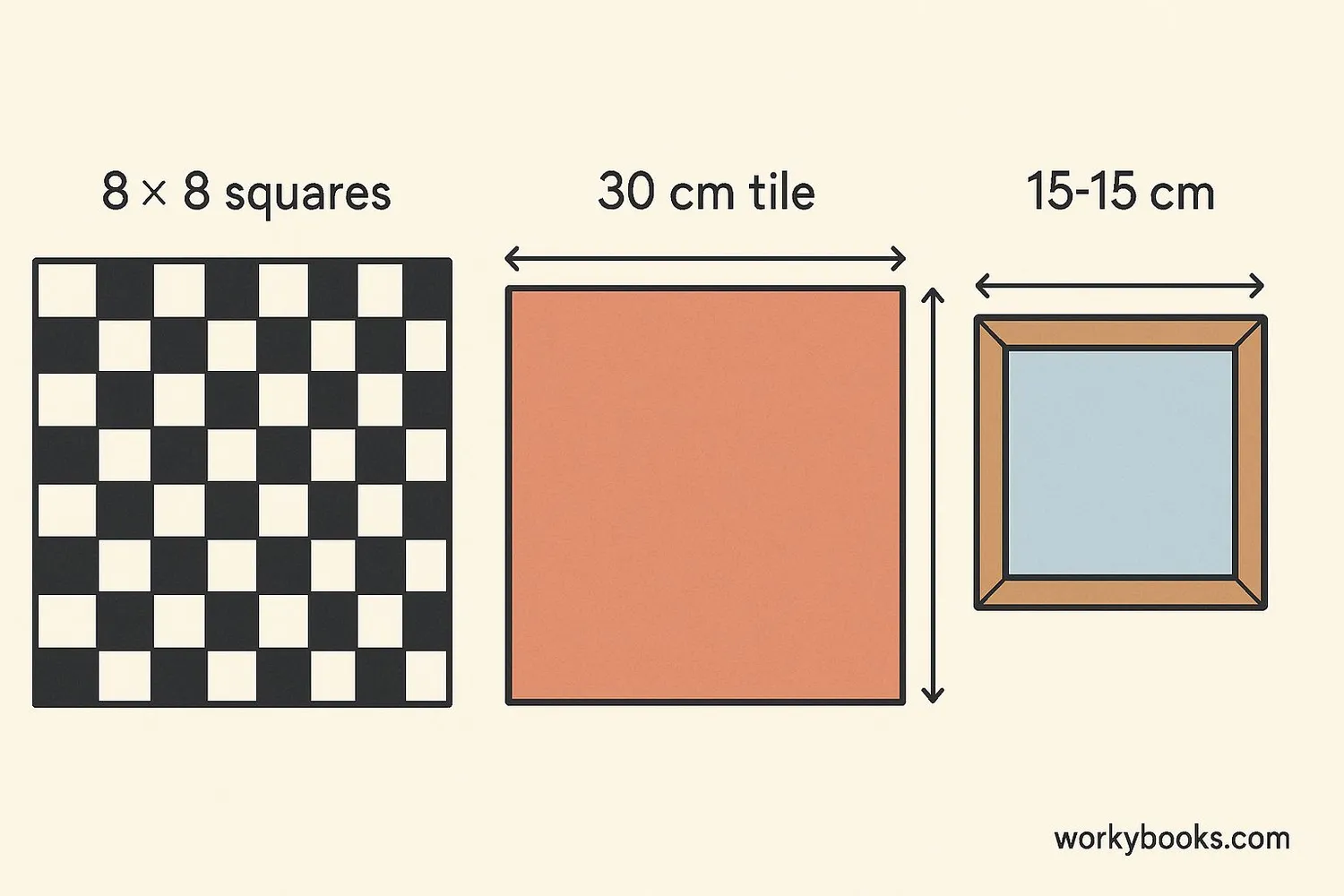
Squares appear wherever equal dimensions and right angles simplify layout: floor tiles, chessboards, windows, picture frames, panels, paving modules, and construction setout. In measurement work, keeping the side, area and diagonal relationships consistent is also a practical check against mistakes.

Checking whether a layout is square
For construction and site work, a square corner is a 90° corner. The classic 3–4–5 method uses the Pythagorean theorem: mark 3 units along one direction and 4 along the perpendicular direction; a 5-unit diagonal indicates a right angle. The same ratio can be scaled to 6–8–10, 9–12–15, and larger layouts.
| Side length | Area | Perimeter | Diagonal |
|---|---|---|---|
| 1 unit | 1 u² | 4 u | 1.414 u |
| 2 units | 4 u² | 8 u | 2.828 u |
| 5 units | 25 u² | 20 u | 7.071 u |
| 10 units | 100 u² | 40 u | 14.142 u |
How to interpret a square result
Start with the unit and the known quantity. If the result is an area, expect square units; if it is a distance, expect the original length unit. For a quick reasonableness check, compare the calculated diagonal with the side: it should be about 1.414 times the side.
Square calculator FAQ
The area is the side length multiplied by itself: A = a².
Take the positive square root: a = √A, because a physical side length is non-negative.
Multiply the side by √2: d = a√2. This follows from a² + a² = d².
First recover a = P/4, then use A = a². Combining the two gives A = P²/16.
The inradius touches the midpoint of each side, while the circumradius reaches a vertex. For a square, r = a/2 and R = a/√2.
The geometry relationships are useful for checking dimensions, but field work should also follow the project's required tolerances and local construction rules. The 3–4–5 method is a common Pythagorean right-angle check.